 Editors, reporters and even cartoonists are in the grip of religious McCarthyism.
Freedom of Speech lies bleeding in the gutter, near its dead friend, Rationalism. Superstition struts its stuff.
Religion won’t kill you, but it knows someone who might just beat you till your brains come out of your ears.
We are afraid to even admit our fear, calling it tolerance.
And tracing back our moral cowardice, one name comes to mind – a name that could have belonged to a hero or a martyr in the struggle. Instead, it belongs to a victim – a victim in whose story I played a small and undistinguished part.
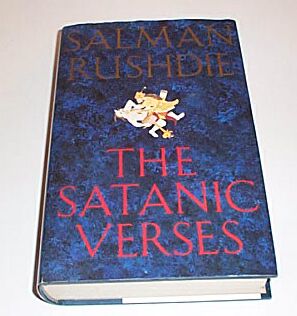
The name itself is not a mystery. To reveal it I would need only to reach up on the bookshelf for my copy of The Satanic Verses and point out the signature, the date and the yellowing wire copy taped to the dust jacket.
Rewind to February, 1989. I was a few months into my first job in television journalism, working for CBS News in London.
In Scotland, they were collecting the last remaining fragments of a Boeing 747 — Clipper Maid of the Seas — and the Lockerbie investigation was close to its first announcement.
On the old Soviet border with Afghanistan, camera crews awaited the retreat of the final column of the Red Army. As a sidebar, a London reporting team had travelled in from the northwest with Hekmatyar’s Mujahideen to report on their plans for a post-Soviet future. In the days before portable satellite dishes, that meant bringing material back to Pakistan, editing for a few days in a hotel, and then heading for a television feedpoint in Peshawar or Islamabad.
As the CBS team cut their pieces in Pakistan, they also did a little routine news work and were caught up in demonstrations that turned nasty. They were stoned by a mob, which decided on the spur of the moment that the heirs of Edward R. Murrow were somehow responsible for a book called The Satanic Verses. The protesters carried signs saying “Death to Rushdie”. Their story made the weekend news, but it was too esoteric to break into the weekday running order.
Then, on 13 February, the man from the placards, Salman Rushdie, appeared on ABC’s Nightline — and that was all the prompting CBS needed to decide they wanted him too.
Calls were made, and next morning a car was sent. Rushdie promised to be an earnest rather than an exciting guest — an alternative to the gamey Cold Warriors and effete royal watchers who usually occupied its 6am slot. Then the agency bells rang on the wires and the first snap reports clattered out, datelined TEHRAN.
CBS had its own cars and its own drivers. The cars had just been fitted with mobile telephones to replace their two-way radios. It never even crossed my mind to call Rushdie and let him know what had happened.
Instead, I phoned the driver and asked him to discreetly turn off the radio. Then came the scramble to get hold of an edition of The Satanic Verses.
A freshly purchased copy was the first thing placed in front of its author on arrival, open at the title page. Sign and date it, please. The request for the date puzzled him, but before an explanation was needed, it was done.
When I asked him if he knew about Khomeini’s edict, he shook his head slowly. He was already reading the wire report as he walked deeper and deeper into the Bureau.
The news was generating some interest and a couple of correspondents and producers left their chess boards and offices and gathered round the sofa that Rushdie had shrunk into. Veterans of the Iran-Iraq war, of conflict in Lebanon and South Africa, they ventured the kind of good-natured remarks that journalists always offer one another.
The author ignored them and asked for cigarettes. A pack of Marlboro was retrieved from a carton of duty-free set aside for just such emergencies. Shoulders down, head slumped, he smoked. From Rushdie I learned the careful choreography required for getting the emotionally damaged on television.
Occupy them, reassure them, appear to give them the opportunity to not go ahead. And never leave them alone.
Rushdie, back then, would have been about my age now.
He was a lively, astute commentator, vocal on left-wing causes. He seemed a future icon for a still-to-be-invented Britain. But from the moment he took in the story of the fatwa and his eyes hollowed, I can only ever remember him for one thing — his complete lack of dignity.
The former English public schoolboy talked about himself in the third person, blending vanity, pomposity and cowardice in a cocktail as thick, yellow and sickly as Advocaat. It would have fitted Flashman, the fictional antihero of Rushdie’s old school, Rugby. Or ‘Cadman, the Fighting Coward’ from the pages of the comic I grew up with — The Victor.
Bravery is not a popularly admired trait these days, but it was The Victor‘s theme, ‘True Stories of Men at War’.
Macaulay’s too:
To every man upon this earth
Death cometh soon or late.
And how can man die better
Than facing fearful odds
For the ashes of his fathers
And the temples of his gods.
Growing up, the thing that frightened me most was showing fear. Salman Rushdie had no such inhibition. Fate gave him half an hour to display a little dignity, some self-deprecating humour in the face of a distant threat. He could not manage it. The interview over, he was given a desk and a phone, a little time to make the necessary calls, and then he disappeared into hiding. Salman Rushdie, victim.
Reading an account by Rushdie’s son of the way the fatwa changed his childhood made me ashamed of my memory of that day. But the awful self-pity of Salman Rushdie made an indelible mark, scratched so deeply that any attempt to cover it up has proved impossible.
Since that day with Salman Rushdie I have put myself in harm’s way professionally, seen people I like and admire suffer or be killed in the name of reporting. I’ve seen bad things, and witnessing them has made me weaker not tougher.
Time has made me revise and temper my opinions, judgments and moral certainties. But not about the author of The Satanic Verses.
(From Press Gazette, February 2006)
2 responses to “Salman Rushdie”
To take that step into bravery, into the face of what intrigues you.
This is good, and appreciated. Others of us aren’t quite so bold.
It’s always nice to say that you’ll be willing to be brave. But there’s nothing wrong with wanting to save yourself, and in this case Rushdie didn’t commit a crime. Maybe one will only feel the same fear if one is in the same situation. Besides, Rushdie had his son’s safety to think of too. Perhaps that was what he was worried and upset over too.