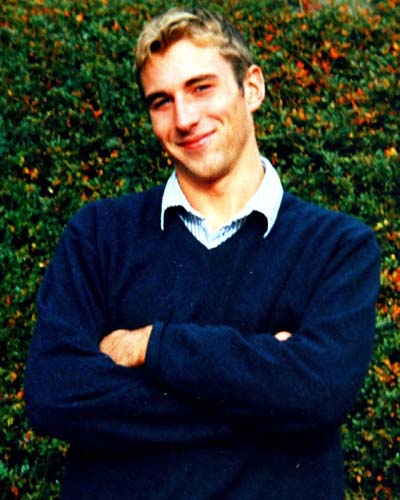
 Whenever people ask me why I left television news (a world which – I have to say – I loved) to run a J-School, I never give the real answer.
Because the real answer is just the name of someone they (and you) probably won’t ever have heard of: Richard Wild.
Richard is gone now. He was shot dead in Baghdad in 2003. I wrote the letter that got him in to Iraq.
You didn’t have to be a genius to see Richard’s potential. He had studied Medieval History at Cambridge, and gone on to do an M.Phil. He’d been a leading light in the student theatre. He was a keen sportsman, and he had a year’s commission as a Lieutenant in the British Army. He was bright, determined and talented.
He was also thoughtful and curious. Most definitely not a self-obsessive looking for a heroic canvas on which to act out a literary psychodrama (yes, you know who you are…).
Richard was going out with the sister of a foreign correspondent friend. He decided that he wanted to be a journalist and he came to see me. For my part, I opened the door to get him a job at ITN, and helped set him on a path that ended with his murder.
(After his death, another foreign correspondent friend – for whom I have great respect – accused me quite plainly of killing him.)
I neither suggested he go to Iraq, nor was I the cold-hearted bastard that shot him. I merely helped expedite his passage, and did some mentoring via email. Some mentor, you might say. And you would be right.
I never had the opportunity to help Richard become the great reporter he undoubtedly would have been. Someone with a gun robbed him of those years, and much more besides.
And so this – journalism education – is my unfinished business.
So when I get angry with glib pundits (not that I’m ever glib or a pundit myself, you understand) talking about journalism and journalists and society and democracy, it’s because it’s not a game. And we need more Richards, and yes fewer – well, you know who I mean.
And perhaps on a bad day, I’d include myself on that second list.
And on a good day, maybe not.
10 responses to “Journalism Education: My Unfinished Business”
This is a fascinating story. I hope you still don’t believe you aided in his death, because it all just seemed like bad timing. I love when journalists have a reason for their passion. It’s a sad story…but also somehow inspiring.
Funny, I always thought it was because the college was the only place that would give you a job. What a silly misconception!
@Alex – no, I don’t think I did.
@Mike – last of the Australian sentimentalists…
I’m italian student. I love journalism and I hope to have a mentor like you. I’ll listen to Perugia.
That’s a tough one to carry around Adrian. I remember reading about Richard in The Guardian and posted briefly on him last year.
It struck me as well, as often when asked by friends wanting to get a relative into journalism my advice was along the lines of …”travel if you can to the story”.
If it’s a hot zone and you consider you have a good head, then be cautious, but go for it. I gave such advice to a senior exec from Chatham House, who would become my mentor.
For it was while fortuitously in a BBC studio interviewing South Africa’s Embassy head Kent Durr about the Boipatong Massacres with my soon -to-be-mentor there, that following the discussion, I made the decision to relocate to South Africa for 18 months.
One of the then BBC producers in Joburg was a savvy, streetwise, six-languages speaking journo who would take me off to see the local Totseis. “David you just need these people to see you. They carry a lot of clout”, he’d whisper.
Though I was extremely cautious, I look back on those times travelling around the townships; night time drives in some of the worst troubled spots, and sometimes question what I was doing. I was a freelancer. A report brought in 200 UKP, but on one occasion I signed a disclaimer as I climbed into a truck for a night patrol in Katlehong – then designated the murder capital of the world.
My advice to new journalists now has changed somewhat. Richard’s death was one of the straws.
[…] valg om å forlate en høyt profilert karriere som utenrikskorrespondent og TV-journalist var drapet på en ung journalist han hjalp å komme seg til Irak. Adrian kaller journalistutdannelse sitt “ufullendte prosjekt”. Derfor var det […]
[…] also be giving a modest sum for the highest scoring MA project, which will be a prize in memory of Richard Wild. The first £250 will be handed out this autumn, so any City students reading, heads down for the […]
[…] also be giving a modest sum for the highest scoring MA project, which will be a prize in memory of Richard Wild. The first £250 will be handed out this autumn, so any City students reading: heads down for the […]
i imad from iraq who tried to save life British journalist named Richard Wild, who was killed in the war 2003
Then I left my studies because of exposure to some harassment of the terrorists
Friends Richard gave me fax thanks (Letter of thanks) from Jeremy Corbyn and tall me If you need help go to you and now I need necessary to help
I lost my study because of this humanitarian work
We lost Richard ten years ago. He was doing what he wanted to do, albeit he was very nervous about it latterly. I had military friends in Iraq who were looking out for him. This was a tragic set of events. Please, do not feel guilty. If you had not helped him, he would have found another way. I miss him. He would be devastated if he felt that he had had such a huge impact on another person’s career path.